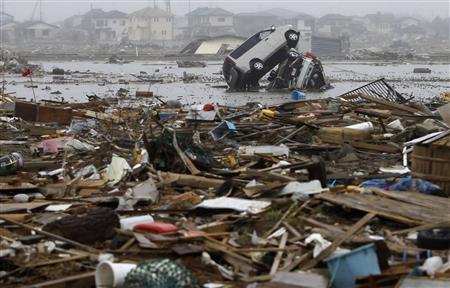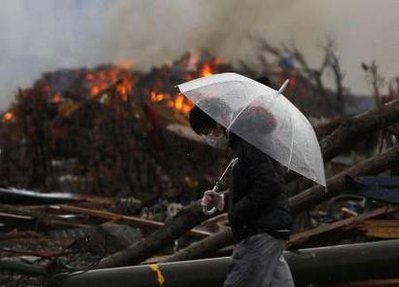
Japan will send nearly 25,000 soldiers backed by boats and aircraft into its disaster zone Monday on an intensive land-and-sea mission to recover the bodies of those killed by last month's earthquake and tsunami, the military said.
Agriculture officials also plan to send a team of veterinarians into the evacuation zone around a stricken nuclear plant to check on hundreds of thousands of abandoned cows, pigs and chickens, many of which are believed to have died of starvation and neglect. The government is considering euthanizing some of the dying animals, officials said.
About 14,300 people have been confirmed dead so far in the catastrophic March 11 tsunami and earthquake. Another 12,000 remain missing and are presumed killed. Some of their bodies were likely swept out to sea, while others were buried under the mass of rubble.
Cleanup crews have discovered some remains as they gingerly removed rotting debris to clear the area for rebuilding.
But the two-day military search operation will be far more extensive, Defense Ministry spokesman Ippo Maeyama said Sunday.
"We will do our utmost to recover bodies for bereaved families," he said.
A total of 24,800 soldiers will scour the rubble, backed by 90 helicopters and planes, he said. Another 50 boats, along with 100 navy divers, will search the waters up to 20 kilometers off the coast, he said. Police, coast guard and U.S. troops will also take part.
"It's been very difficult and challenging to find bodies because the areas hit by tsunami are so widespread," he said. "Many bodies also have been swept away by the tsunami."
The operation will be the third intensive military search for bodies since the disaster last month. With the waters receding, Maeyama hopes the teams will have more success.
The search was complicated by the decomposition of some of the corpses, he said. Some had already turned into skeletons.
"You have to be very careful in touching the bodies because they quickly disintegrate. We cannot tell the bodies' gender anymore, let alone their age," he said.
The searches will continue, however, "as long as families want us to look for their loved ones," Maeyama said.
Meanwhile, the government in the Fukushima prefecture will send a team of six veterinarians into the 12-mile (20-kilometer) evacuation zone around the radiation-leaking Fukushima Dai-ichi nuclear power plant to survey the livestock there.
Farmers in the area were estimated to have left 3,000 cows, 130,000 pigs and 680,000 chickens behind when they hurriedly fled the area last month when the nuclear crisis started.
With no time for burials, veterinarians who find dead livestock will spray lime over them to prevent them from spreading disease, agricultural officials said.
The government is also considering euthanizing dying animals, but only after getting permission from their owners, said Yutaka Kashimura, an agricultural official in Fukushima.
"Killing animals is the very last resort," he said.
Showing posts with label Quake. Show all posts
Sunday, April 24, 2011
Saturday, April 23, 2011
Japan earmarks first $50 billion for post-quake rebuild
Japan's cabinet approved on Friday almost $50 billion of spending for post-earthquake rebuilding, a downpayment on the country's biggest public works effort in six decades.
The emergency budget of 4 trillion yen ($48.5 billion), which is likely be followed by more reconstruction spending packages, is still dwarfed by the overall cost of damages caused by the March 11 earthquake and tsunami, estimated at $300 billion.
"With this budget, we are taking one step forward toward reconstruction ... and toward restarting the economy," Finance Minister Yoshihiko Noda told reporters after a cabinet meeting.
Unpopular Prime Minister Naoto Kan, under fire for his handling of the crisis, said Japan would have to issue fresh government bonds to fund extra budgets to come, and suggested he would stay on to oversee the process.
"I feel it was my destiny to be prime minister when the disasters and nuclear accident took place," Kan told a news conference.
"I want to work for reconstruction and rebuilding, and present an outline to overcome these two crises. To have that vision in sight is my heartfelt desire as a politician."
Financing the next packages will be much tougher, as they are likely to involve a mix of taxes as well as borrowing in the bond market, which could strain Japan's debt-laden economy.
If Kan is unable to steer those laws through parliament, he may be forced to step down, analysts say.
The magnitude 9.0 earthquake and 15-meter (50-ft) tsunami that followed caused Japan's gravest crisis since World War Two, killing up to 28,000 people and destroying tens of thousands of homes.
It also smashed a nuclear power plant which began leaking radiation, a situation the plant's operator says could take all year to bring under control.
The budget will be submitted to parliament next week and is expected to be enacted in May.
"CAUSED GREAT TROUBLE"
Prime Minister Kan, who has been accused by opposition politicians, his own party and quake survivors of failing to take command of the response to the triple disaster, has said the need to rebuild is an opportunity for national "rebirth."
A Jiji news agency opinion poll showed Kan's support rate stood at 20.5 percent, up a scant 1.6 points from the previous month, with more than three out of four voters saying he had exercised little or no leadership over the nuclear crisis.
About 57 percent said they were supportive of a tax rise to finance reconstruction compared with 38.6 percent who were not.
In a Reuters poll of retail investors released on Friday, 83 percent of those surveyed said they disapproved or strongly disapproved of the administration's handling of the crisis.
As well as trying to rebuild the ruined northeast of the country, Japan also has to contend with the world's worst nuclear crisis since the 1986 Chernobyl disaster, the wrecking of the Fukushima Daiichi plant, 240 km (150 miles) from Tokyo.
Radiation spilled out from the facility after a hydrogen explosion, and in their battle to cool melting fuel rods, engineers pumped radioactive water into the Pacific, a move that worried Japan's neighbors about the spread of contamination.
Masataka Shimizu, the much-criticised president of plant operator Tokyo Electric Power (TEPCO), visited an evacuation center for the first time since the disaster struck, kneeling and bowing deeply to the evacuees.
"I want to work hard so that you can go home," he said. Mostly subdued evacuees pleaded with him to bring the crisis to an end so they could go home. "I want you to act as if it had happened to your own family," said one man.
Earlier, dressed in blue work clothes, Shimizu apologized to Fukushima's regional governor, Yuhei Sato.
"I apologize from the bottom of my heart for the great trouble caused to many people in society," he said.
Shimizu's company has been accused of downplaying the dangers and ignoring warnings about the risk of a quake and tsunami striking the plant, as well as reacting poorly to the damage.
Japan said this week it would ban anyone entering a 20-km (12-mile) evacuation zone around the plant.
Tuesday, April 19, 2011
Japan Quake Caused Surprisingly Severe Soil Collapse
The scale of Japan's March 11 earthquake and tsunami wasn't the only thing that surprised geologists.
The 9.0 earthquake in Japan — the fourth most powerful quake ever recorded — also caused an unusually severe and widespread shift in soil through liquefaction, a new study suggests.
Near coastlines, harbors and rivers, earthquakes can make the wet, sandy soil jiggle, turning it temporarily from a solid to a liquid state, a process known as liquefaction. Heavy sand and rock sinks, while water and lighter sand bubble to the surface. The slurry spreads, often toward the water, and the surface shifts.
Japan's liquefaction occurred over hundreds of miles, surprising even experienced engineers who are accustomed to seeing disaster sites, including from the recent earthquakes in Chile and New Zealand.
Other areas vulnerable
The study raises questions about whether existing building codes in other vulnerable locations can enable structures to withstand massive liquefaction, including in areas of Oregon, Washington and California.
"We've seen localized examples of soil liquefaction as extreme as this before, but the distance and extent of damage in Japan were unusually severe," said Scott Ashford, a study team member from Oregon State University.
"Entire structures were tilted and sinking into the sediments, even while they remained intact," said Ashford, who is based in Corvallis, Ore. "The shifts in soil destroyed water, sewer and gas pipelines, crippling the utilities and infrastructure these communities need to function. We saw some places that sank as much as 4 feet," or 1.2 meters.
Long-lasting quake
The duration of the Japanese earthquake, about five minutes, could be the key to the severity of the liquefaction and may force researchers to reconsider the extent of liquefaction damage possible.
"With such a long-lasting earthquake, we saw how structures that might have been okay after 30 seconds just continued to sink and tilt as the shaking continued for several more minutes," Ashford said. "And it was clear that younger sediments, and especially areas built on recently filled ground, are much more vulnerable."
An event almost exactly like Japan's is expected in the Pacific Northwest from the Cascadia Subduction Zone, and the new findings make it clear that liquefaction will be a critical issue in the young soils there.
"Young" sediments, in geologic terms, are those deposited within the past 10,000 years or so. In Oregon, for instance, that describes much of downtown Portland, the Portland International Airport, nearby industrial facilities and other cities and parts of the Willamette Valley.
About 1,100 bridges in Oregon are at risk from an earthquake on the Cascadia Subduction Zone, according to the Oregon Department of Transportation. Fewer than 15 percent of them have been retrofitted to prevent collapse.
Some damage may be reduced or prevented by different construction techniques or retrofitting, Ashford said. But another reasonable goal is to at least anticipate the damage — to know what will probably be destroyed, make contingency plans for what will be needed to implement repairs, and design ways to help protect and care for residents until services can be restored, the researchers say.
Monday, April 11, 2011
Powerful aftershock hits Japan on 1 month anniversary of fourth largest quake
One month ago the fourth largest earthquake in the world since 1900 struck Japan bringing death and destruction to the nation. Today the country was rocked by a significant aftershock and more evacuations around a stricken nuclear power plant were ordered.
At 5:16pm local time (8:16 UTC) a magnitude 6.6 temblor struck on Japan’s mainland 22 miles from Iwaki in the Fukushima prefecture. The quake was felt across the island of Honshu including 100 miles away in Tokyo and at the severely damaged Fukushima nuclear power plant to the north.
Landslides in the city of Iwaki brought on by the aftershock have trapped several people in three houses that were buried officials said. Fires were burning in some parts of northeastern Japan and power was knocked out to 220,000 homes and businesses.
Immediately following the aftershock Tokyo Electric (TEPCO) ordered the workers at the power plant to evacuate to safer areas. Power was briefly cut to the stricken plant but soon restored.
Today’s aftershock follows on a more significant magnitude 7.4 aftershock last week. Hundreds of smaller aftershocks have struck the region since last month’s magnitude 9.0 quake and tsunami.
Officials recommend more evacuations to escape radiation threat
The Japanese government announced today that it was recommending that more residents in the area of the Fukushima Dai-ichi nuclear complex evacuate due to the potential for long term health threats. The new evacuations include the towns of Katsuo, Kawamata, Namie, Iitate and parts of Minami Soma.
Chief Cabinet Secretary Yukio Edano said, "This policy does not require immediate evacuation right away, but we take the long-term perspective, considering the long-term effect of radiation on your health.”
A 12 1/2 mile (20km) radius total evacuation zone has already been established around the failed nuclear power plant. Residents living from 12 1/2 miles to 18 1/2 miles (30km) from the plant have been ordered to stay inside.
Death toll continues to climb
The death toll from the March 11 earthquake and tsunami continues to climb. The latest numbers from the National Police Agency of Japan report 13,130 have been confirmed killed. An additional 13,718 are still missing and are largely expected to not be found and added to the death toll.
Rebuilding of the nation, particularly along the coastal regions where the tsunami sent a wall of water far inland, will be a long and difficult task. More than 48,00 structures were totally destroyed by the quake and tsunami and an additional 152,000 were damaged.
The magnitude 9.0 earthquake now ranks as the fourth largest in the world since 1900 and the most powerful to strike Japan since instrumented readings began. It is likely that when the final death toll is realized the event will be Japan's fourth deadliest quake in history.
Sunday, April 3, 2011
Death toll in Japan quake, tsunami tops 12,000
The death toll from the recent 9.0-magnitude quake and tsunami in has surpassed 12,000, while nearly 15,500 remain unaccounted for, the Kyodo news agency reported on Sunday.
The twin disaster that hit Japan on March 11 also triggered a number of explosions at the Fukushima nuclear power plant, which caused several radioactive leaks.
Over 165,000 people have been evacuated from the disaster zone and accommodated in temporary refuge centers across the country, while tens of thousands more still do not have electricity or running water.
The Japanese government has said the damage from the disaster could total $310 billion.
Meanwhile, Russian emergencies services said on Sunday that radiation levels are within the norm in Russia's Far East and the danger of radioactive pollution in the region following the nuclear crisis at Fukushima is unlikely.
Wednesday, March 16, 2011
New aftershock rattles quake-devastated NE Japan
TOKYO – A new aftershock of 6.0 magnitude has rattled northeast Japan.
Scores of strong aftershocks have followed the 9.0 magnitude earthquake that struck Friday and caused a devastating tsunami.
The U.S. Geological Survey said the new aftershock struck about 1 p.m. Wednesday near the coast of Honshu in northeast Japan.
That's about 59 miles (95 kilometers) from the capital, Tokyo.
Two aftershocks Tuesday afternoon caused buildings in Tokyo to sway. They were measured at 6.0 and 6.2 magnitude.
Subscribe to:
Posts (Atom)